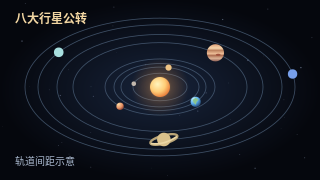
The eight planets in order, and how long they take to orbit
From the smallest to largest orbit, the planets are Mercury, Venus, Earth, Mars, Jupiter, Saturn, Uranus and Neptune. A planet farther from the Sun takes longer to complete one orbit. Mercury takes about 88 days, Earth takes about a year, and Neptune takes about 165 years.
What changes when you switch the scale?
The astronomical unit, or AU, is about 149.6 million km. Earth’s semimajor axis is about 1 AU and Neptune’s about 30 AU. In the To scale view, Earth’s orbit radius is about one thirtieth of Neptune’s, and all four terrestrial planets orbit within 2 AU.
The Overview compresses the spacing so the eight planets fit together. Periods separates two orbits to make their lap counts easy to read. All three views show circular orbits in a common plane and enlarge the planetary bodies for visibility.
Orbital distances and periods
| Planet | Type | Semimajor axis | Sidereal orbital period |
|---|---|---|---|
| Mercury | Terrestrial | 0.387 AU | 88.0 days |
| Venus | Terrestrial | 0.723 AU | 224.7 days |
| Earth | Terrestrial | 1.000 AU | 365.3 days |
| Mars | Terrestrial | 1.524 AU | 687.0 days |
| Jupiter | Gas giant | 5.203 AU | 11.86 years |
| Saturn | Gas giant | 9.537 AU | 29.45 years |
| Uranus | Ice giant | 19.189 AU | 84.02 years |
| Neptune | Ice giant | 30.070 AU | 164.79 years |
A sidereal orbital period is the time needed to return to the same direction around the Sun relative to distant stars. The model uses 365.25 days per year.
Try it in the simulation
- Work outward in the overview and note each planet’s orbital semimajor axis and period. Switch to To scale and zoom in on the inner planets to see why the overview compresses spacing.
- Open Periods and select Mercury. Predict its lap count when Earth completes one orbit, then select Earth: one orbit to check. Mercury makes about 4.15 orbits.
- Choose Neptune. In the same time Neptune completes about 0.006 of an orbit. Advance to one Neptune orbit and check how many orbits Earth has made.
Frequently asked questions
What is the order of the eight planets from the Sun?
Mercury, Venus, Earth, Mars, Jupiter, Saturn, Uranus and Neptune. This order uses the semimajor axis of each planet’s orbit. Pluto is a dwarf planet.
Why do more distant planets take longer to orbit the Sun?
They travel farther around their orbits and move more slowly on average. Kepler’s third law relates the square of the period to the cube of the orbit’s semimajor axis for objects orbiting the same central mass.
How many times does Mercury orbit in one Earth year?
An Earth sidereal year is about 365.26 days and a Mercury year about 87.97 days. Dividing gives about 4.15 Mercury orbits.
Does true orbital scale show the Sun and planets at their real relative sizes?
True orbital scale applies to orbit radii. The Sun and planets are enlarged to keep them easy to see and select. Orbits are shown as coplanar circles, with illustrative starting positions.
Classroom use and data
Use the simulation to connect the order of the planets to astronomical units and Kepler’s third law. Orbital distances and sidereal periods are from NASA JPL planetary data. Starting positions, body sizes and surface textures are illustrative.