What causes tides and why does the range change?
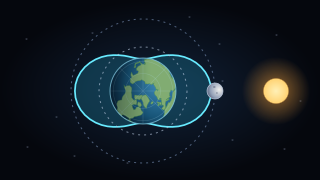
Tides are driven by differences in the pull of the Moon and Sun across Earth. In the equilibrium model, the tidal surface bulges near and far from the Moon. Rotate the observer through the two bulges, then move the Moon to see how the Sun’s tidal contribution changes the range.
Tidal acceleration and the far-side bulge
The Moon pulls Earth’s near side more strongly than its center and the far side less strongly. Subtract the acceleration at the center. On the near side the difference points toward the Moon, and on the far side it points away. Both point outward relative to Earth’s center. At right angles to the Moon’s direction the difference points inward.
In the daily scene, the equatorial observer moves around once relative to the model’s Moon direction in an average lunar day of about 24 h 50 min. It passes two high points and two low points. The tidal range is the difference between high and low water.
Compare the range over a lunar month
| Moon phase | Alignment | Range |
|---|---|---|
| New moon | Sun and Moon in nearly the same direction. | Larger, spring tide. |
| First quarter | Sun and Moon about 90° apart. | Smaller, neap tide. |
| Full moon | Sun and Moon in nearly opposite directions. | Larger, spring tide. |
| Last quarter | The tidal axes are close to perpendicular again. | Smaller, neap tide. |
Spring tide refers to the larger range around new and full moon, in any season. In the model the lunar and solar effects add along the same axis at those phases, even when the Sun and Moon are on opposite sides of Earth.
Try it in the simulation
- In Daily tides, drag the gold observer around Earth and compare its position with the highs and lows on the graph.
- In Spring and neap tides, select new moon, first quarter and full moon. Compare the range, then turn off the Sun’s contribution.
- In Tidal force, drag the Moon and follow the arrows at the near side, far side and at right angles to the Moon.
Frequently asked questions
Why is there a tidal bulge on the far side of Earth?
The Moon pulls less strongly on the far side than it does on Earth’s center. Relative to the acceleration of the center, the difference points away from the Moon on the far side and toward the Moon on the near side. Both differences point outward.
Why do spring tides occur at both new and full moon?
The lunar and solar tidal effects each have high points on both ends of an axis. At new and full moon the axes are nearly aligned, increasing the range. Near first and last quarter the axes are nearly perpendicular and the range is smaller.
Does every coast get two high tides a day?
The idealized equatorial observer sees two highs and two lows in a lunar day of about 24 hours and 50 minutes. Some real coasts have only one high tide a day, while others have two highs of different heights.
Can this simulation predict a harbor’s tide times?
Local tides depend on coastlines, ocean basins, depth and additional tidal components. Use an official tide table for times and heights at a specific site.
Classroom use
Use the simulation to distinguish the gravitational pull of the Moon from the difference across Earth that drives tides. The heights, sizes and distances are illustrative. Real oceans respond to the shape and depth of basins and coastlines.